AI Judgment
Routes the flow on an AI agent's answer to a yes/no question about the data passing through: "Is this on-brand?", "Is this headline clickbait?", "Does this already exist?". Reach for it when the decision needs reading and judgment rather than a comparison. Routes to true when the agent answers yes, otherwise to false.
Fields
| Field | Description |
|---|---|
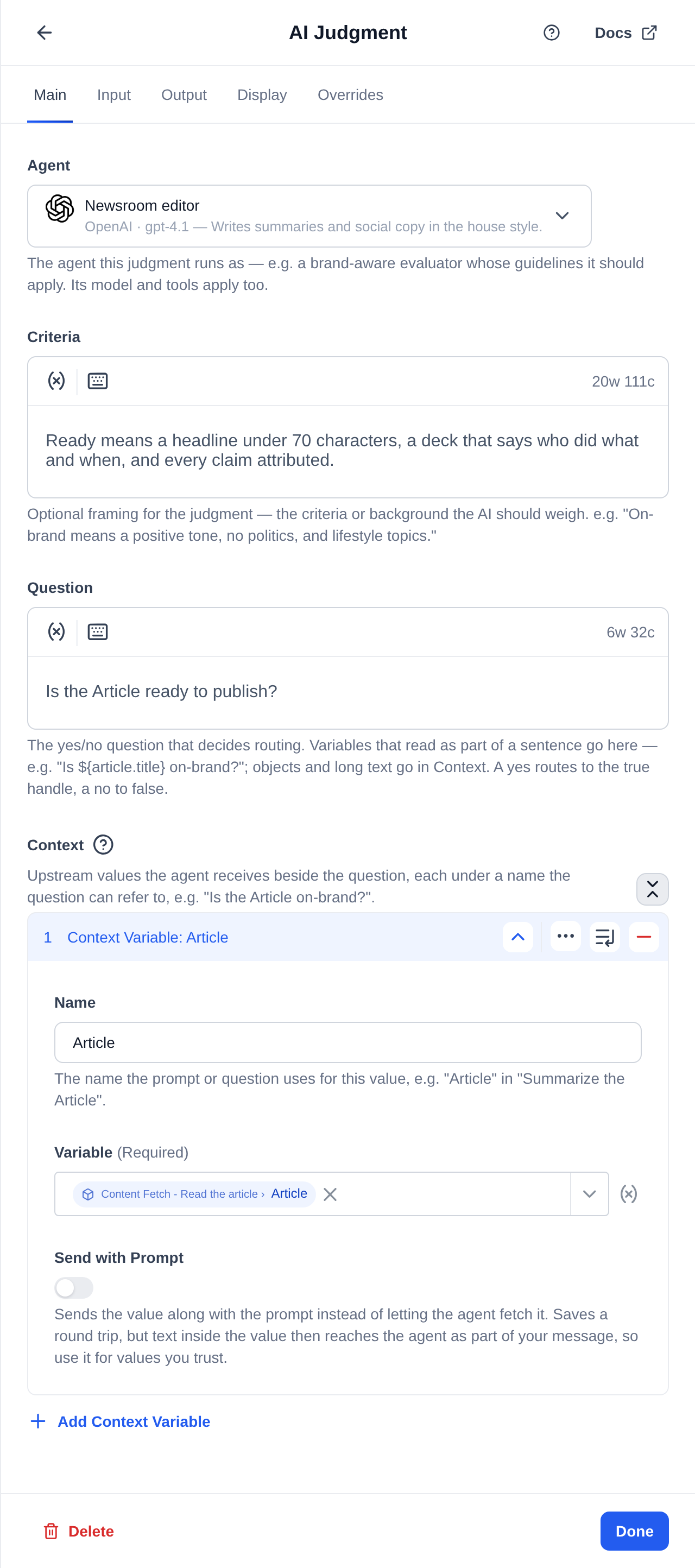
| Agent | The agent this judgment runs as, such as a brand-aware reviewer whose guidelines it should apply. Its model and tools apply too. Where the deployment permits, it can be left blank to run on the deployment's own AI configuration. |
| Criteria | Optional framing: the criteria or background the agent should weigh, such as "On-brand means a positive tone, no politics, and lifestyle topics." |
| Question | The yes/no question that decides the route. Accepts variables for values that read as part of a sentence, such as a headline. |
| Context | Earlier steps' values the agent receives beside the question, each under a Name the question can refer to, such as an Article for "Is the Article on-brand?". Works as it does on the AI Agent action. |
Overrides
| Field | Description |
|---|---|
| Model Override | Run this judgment on a different Provider Account and Model than its agent's, with an optional Reasoning Effort. Leave unset to inherit. |
| Ignore Agent Instructions | Run this judgment without the agent's standing instructions. The criteria, question and context still apply. |
| Tool Sources Override | MCP servers this judgment draws tools from in place of its agent's, for example a CMS, so it can check whether matching content already exists. Leave empty to inherit the agent's; when set, it replaces the agent's whole list, and the note beneath the field shows what changes. A judgment only ever gets a server's read-only tools. |
Criteria and Question are joined into the task the agent is given, so it's up to you how you split the text between them. The question is what has to be there: a judgment with no question fails at run time.
What later steps see
The incoming data, passed through unchanged on whichever path was chosen.
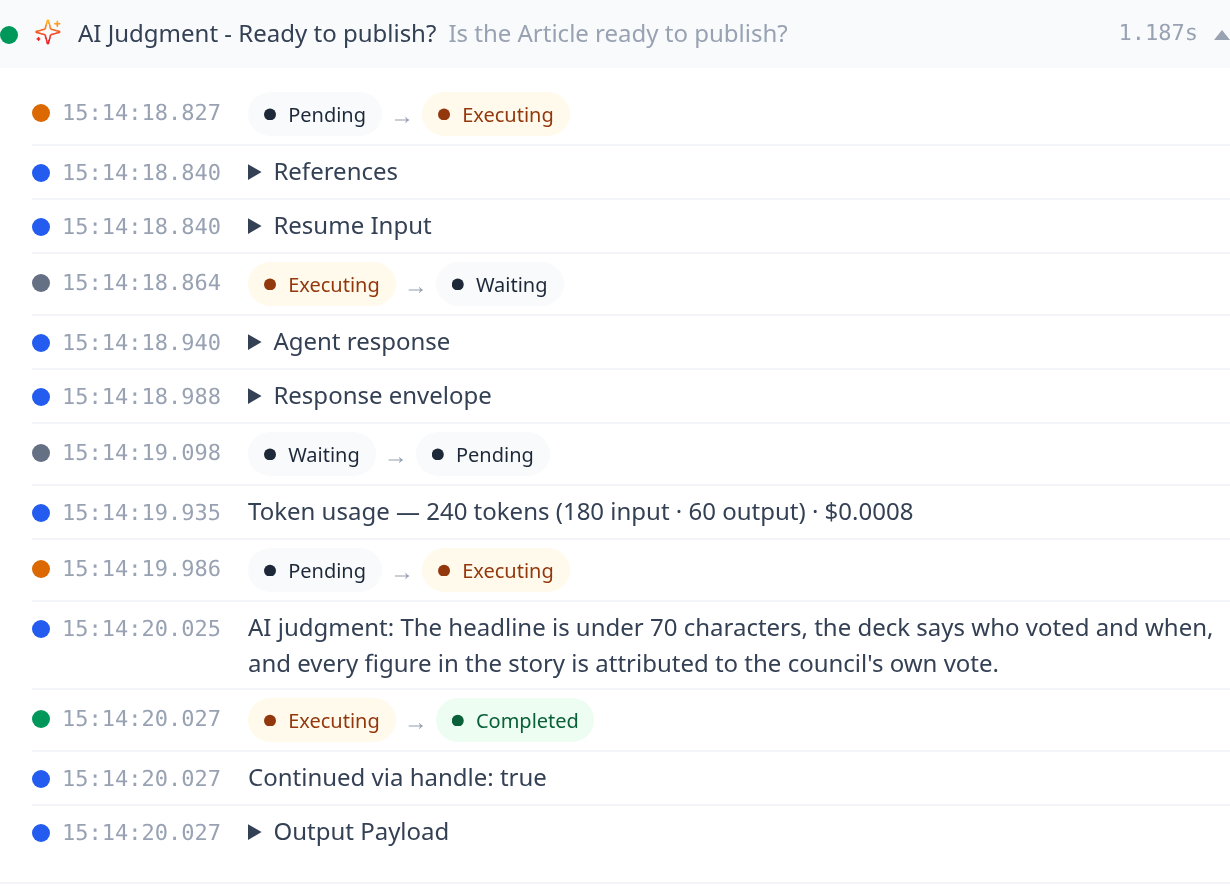
The agent's reasoning for its answer is written to the step's log, so a branch taken weeks ago is still explainable.
When the agent can't give a clear yes or no, when the model returns nothing usable, or when the provider errors, the step fails rather than guessing a branch. A failed step takes the node's error path when one is turned on; otherwise the run fails. An uncertain agent picks the answer that best fits and notes the uncertainty in its reasoning.
Read-only by design
Deciding a route must not change anything, so this node's agent is only ever offered read-only tools, in a live run as much as in a dry run. Work that changes things belongs in an AI Agent action placed after the branch.
Which model it runs on
The step's own Model Override, else the agent's model, else the workspace's Default Model; the note at the top of the form reports what the step will actually run on. See How a model is chosen.