OpenAPI action
Calls an operation described by an OpenAPI specification, a standard description of a web API. In the action picker it is OpenAPI, under General Actions. It needs no connection.
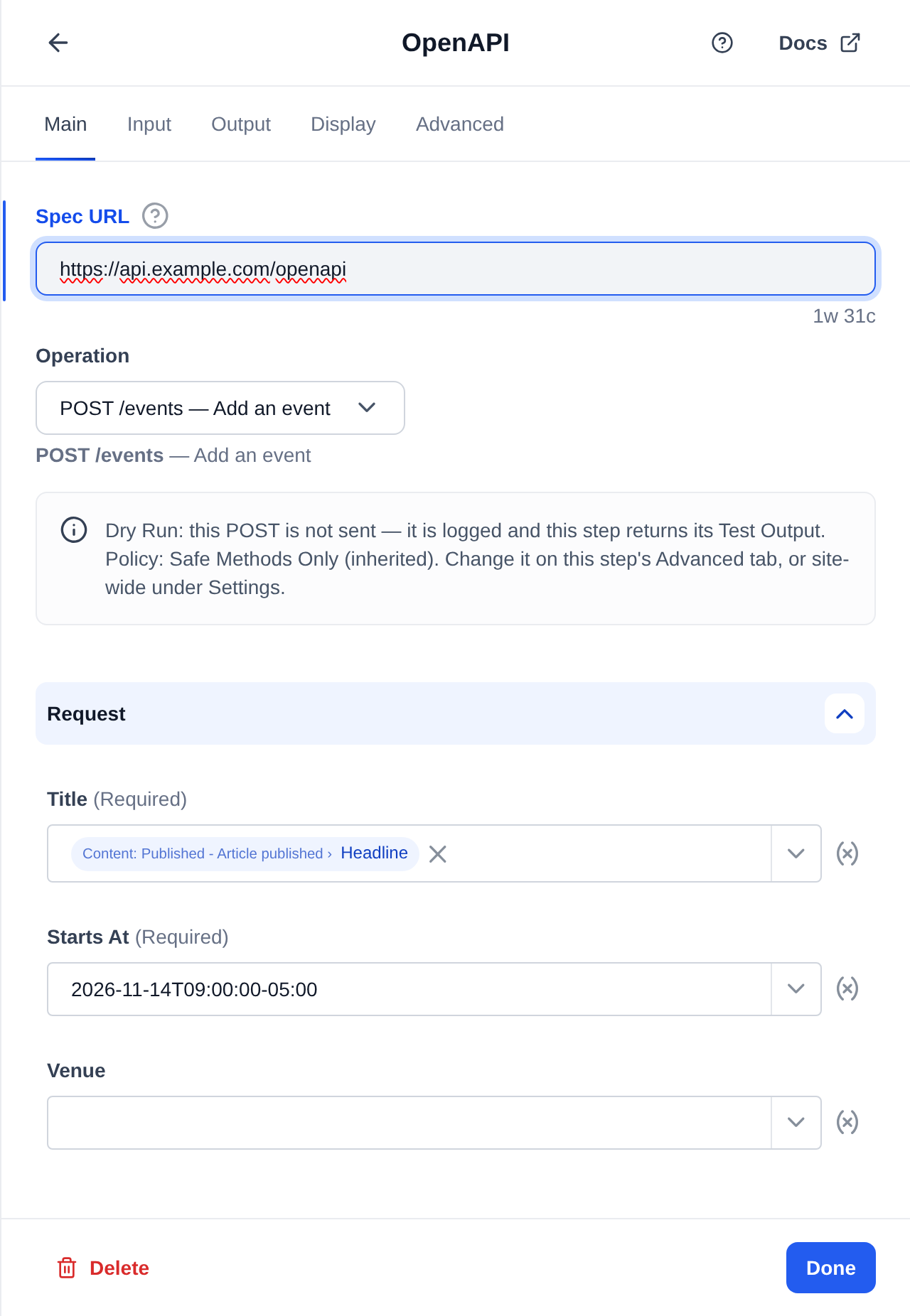
Fields
| Field | Required | Description |
|---|---|---|
| Spec URL | Yes | The URL of the OpenAPI specification, which must use https://. It is fetched and checked as you enter it, and a note reports what was found, or why the specification couldn't be read. |
| Operation | Yes | The operation to call, chosen from the operations that specification defines. The picker names each one with its method and path. |
| Dry Run: Outbound HTTP | No | On the Advanced tab. Overrides the workspace's policy for what this step sends during a dry run. Leave it unset to use that policy. |
The form builds itself
Pick an operation and the form grows a field for each of that operation's path, query and header parameters, and for each property of its request body. A parameter's own description from the specification becomes the field's note, a parameter with a fixed set of values becomes a picker rather than a text box, and a required parameter is marked required. Most of these fields accept variables, so the call can be built from the trigger's data and earlier results.
For example, pointing Spec URL at a weather service's specification and choosing its "current conditions" operation produces a form with that operation's city and units parameters, ready to fill from an earlier step.
Authentication
The step has no authentication of its own. If the service needs an API key, the specification declares the header or query parameter that carries it; that parameter appears in the form like any other, and you fill it from a secret rather than typing the key in. A service that needs OAuth is better reached with an HTTP Request through a Custom OAuth connection.
What a dry run sends
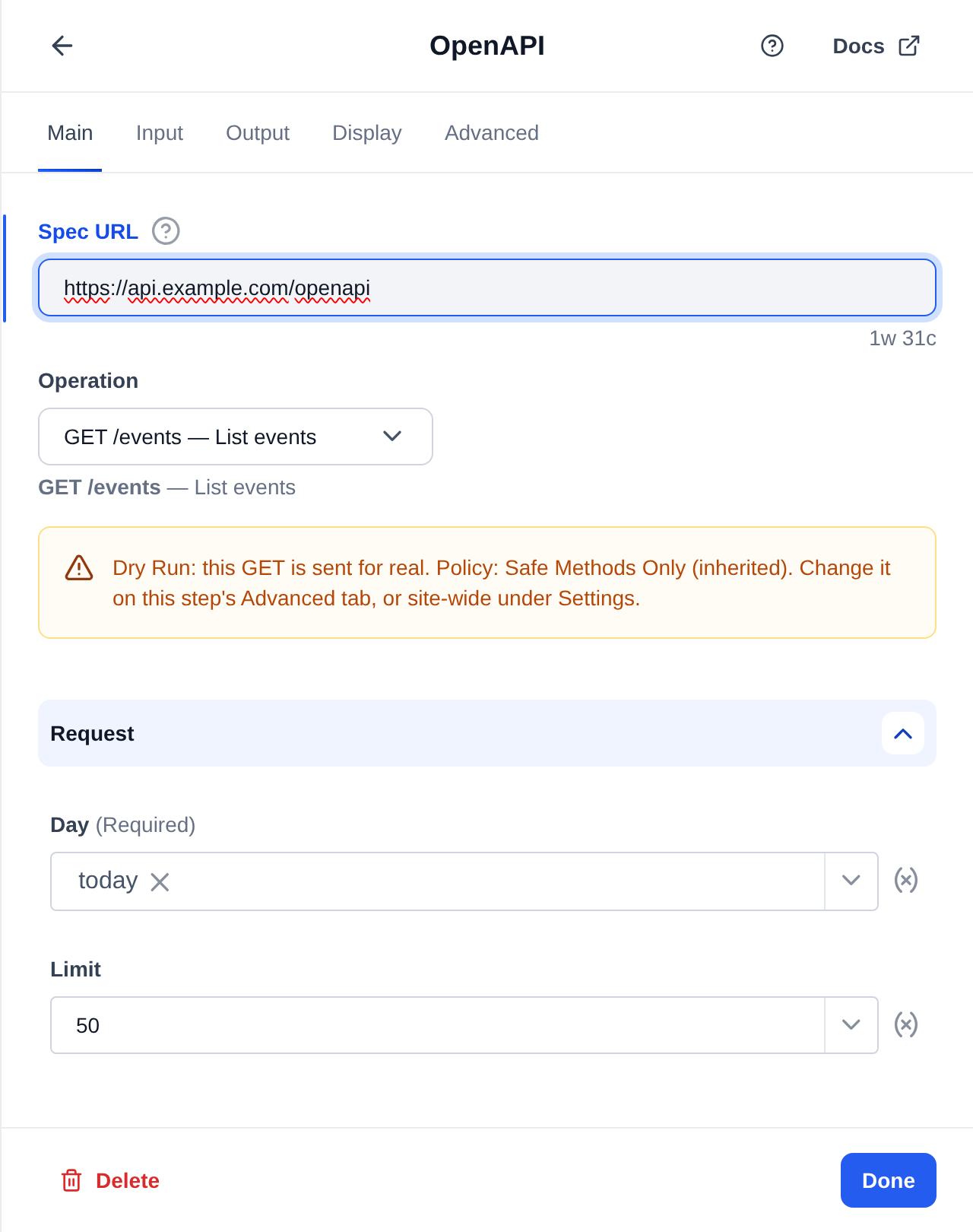
A dry run follows the workspace's Dry Run: Outbound HTTP policy, explained under Outbound HTTP during a dry run: this step classifies a call by its HTTP method, so with the default policy a read-only operation is sent for real and one that writes is logged and skipped. An endpoint is free to break that convention; set the step's policy to None if you cannot vouch for the operations being called.
Output
The operation's response, shaped by the response schema the specification defines for it, so later steps can reference its fields by name.
Limits
- The specification must be self-contained. One that refers to another document, with a
$refto a URL or a file, is refused, and the note under Spec URL says so. Ask the service for a bundled, single-file specification, or bundle it yourself. - No local network addresses. The specification's URL and the server it names are held to the same rule as an HTTP Request: an address on this server's own network is refused unless the platform operator has allowed local network requests.
- Path values are encoded. A path parameter's value is written into the URL encoded, so a value holding a slash or a question mark can't lengthen the path or start the query, and a value of
.or..fails the step.